
Newborn Screening Gave Maddie’s Family an Answer. Support Helped Them Navigate What Came Next.
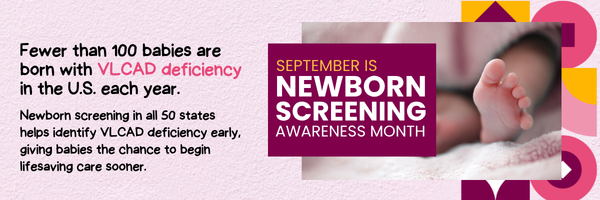
September is Newborn Screening Awareness Month, but for the Bauer family, the importance of this simple test revealed answers they didn’t know they needed.
At just 24 hours old, Maddie experienced an episode of dangerously low blood sugar.
No one knew why.
She received treatment, and her blood sugar stabilized, but her parents were left without an explanation for what had happened.
Six days later, the Bauer family received the phone call that began connecting the dots.
Maddie’s newborn screening showed that she may have Very Long-Chain Acyl-CoA Dehydrogenase (VLCAD) deficiency, a rare genetic metabolic disease that prevents the body from properly breaking down certain fats for energy. [1]
Suddenly, that unexplained low blood sugar made sense.
Newborn Screening Gave the Bauer Family the Chance to Act
Maddie looked like a healthy newborn. There was no outward sign that her body was struggling to produce the energy it needed.
For someone with VLCAD deficiency, fasting, illness, prolonged activity, and other physical stressors can leave the body without the energy it needs. Depending on the type and severity of the disease, complications can include dangerously low blood sugar, muscle breakdown, liver problems, cardiomyopathy, metabolic crisis, coma, or death.[1][2]
Newborn screening gave the Bauer family an answer, and the opportunity to act.
Maddie was connected with a metabolic genetics team, received confirmatory testing, and began treatment. Her parents started learning how long she could safely go without eating, how to protect her during illness, which warning signs required immediate attention, and what to do during an emergency.
These early steps matter. Current clinical guidance recommends promptly evaluating a baby after an abnormal VLCAD newborn screening result, teaching caregivers how to avoid prolonged fasting, and beginning immediate medical intervention when needed while confirmatory testing is underway.[2]
For the Bauer family, newborn screening was more than a routine test.
It explained what had happened.
It connected Maddie with specialized care.
It gave her family the knowledge they needed to begin protecting her.
Fewer Than 100 Babies Each Year Are Born with VLCAD
The Health Resources and Services Administration estimates that fewer than 100 babies are born with VLCAD deficiency in the United States each year.[1]
VLCAD is included as a core condition on the federal Recommended Uniform Screening Panel, or RUSP. The RUSP identifies conditions that the U.S. Department of Health and Human Services recommends every newborn be screened for, although individual states determine the conditions included in their programs.[3] Every state operates a newborn screening program, but state screening panels and follow-up processes can vary.[4]
Newborn screening for VLCAD is performed using a small amount of blood collected from a baby’s heel. The screening measures specific substances in the blood that may indicate the baby is having difficulty processing certain fats for energy.[1]
An out-of-range result is not a final diagnosis. It does mean that a baby needs prompt follow-up and additional testing, which may include blood or urine testing, genetic testing, and an evaluation of the heart.[1]
For VLCAD, that follow-up cannot wait. Babies with the condition can develop serious health problems if they are not diagnosed and treated quickly, and some may need treatment even before symptoms are visible.[1][2]
Those few drops of blood can mean the difference between wondering what is wrong and having a path forward.
The Diagnosis Is Only the First Step
Newborn screening can provide an answer, but the phone call is only the beginning of a much longer journey.
Families are suddenly asked to become experts almost overnight.
They have to learn about feeding and fasting guidelines, sick-day protocols, medications, emergency plans, lab results, and the signs of a metabolic crisis. They must learn how to advocate for their child in emergency rooms, childcare settings, schools, and throughout everyday life.
They are trying to absorb all of this while caring for a newborn and processing the news that their child has a lifelong rare disease.
This is the experience of so many families after a VLCAD diagnosis. They may leave that first appointment with a folder of medical information but still have questions no handout can fully answer.
How will this affect everyday life?
How do other families handle illness, travel, school, or feeding challenges?
Where can they find information they can trust?
Is there anyone else who truly understands?
That is where Maddie’s Spark Foundation comes in.
Helping Families Find Support After Diagnosis
We are working to make sure the next family who receives that terrifying phone call does not feel like they have to navigate VLCAD alone.
With the support of our donors and community, Maddie’s Spark Foundation can:
Create practical resources for newly diagnosed families
Share clear, trustworthy educational content about VLCAD
Connect families with others who understand this journey
Help parents feel more informed and prepared to advocate for their child
Continue raising awareness so VLCAD families feel seen and supported
Newborn screening can identify VLCAD, but families still need support as they learn how to live with it.
This Newborn Screening Awareness Month, you can help us be there for the next family. Your donation allows us to continue developing resources, sharing education, and building connections within the VLCAD community.
Because awareness matters most when it helps move us forward—and no family should have to face the road after diagnosis alone.
Learn More About Newborn Screening
Make a Donation to Support VLCAD Families
References
Health Resources and Services Administration. “Very Long-Chain Acyl-CoA Dehydrogenase Deficiency.” Newborn Screening Information Center. Reviewed March 2026.
Leslie ND, Saenz-Ayala S. “Very Long-Chain Acyl-Coenzyme A Dehydrogenase Deficiency.” GeneReviews®. National Center for Biotechnology Information, U.S. National Library of Medicine. Updated August 7, 2025.
Health Resources and Services Administration. “Recommended Uniform Screening Panel.” U.S. Department of Health and Human Services. The panel lists VLCAD deficiency as a core fatty acid oxidation disorder recommended for newborn screening.
Baby’s First Test. “Conditions Screened by State.” Expecting Health. Provides current information about state newborn screening programs and differences among state screening panels.
The information in this article is provided for educational purposes and is not intended as medical advice. Families should consult their metabolic genetics team or another qualified healthcare professional regarding individual diagnosis, treatment, and disease management.
