
Latest International VLCAD Care Guidelines: What Families Should Know
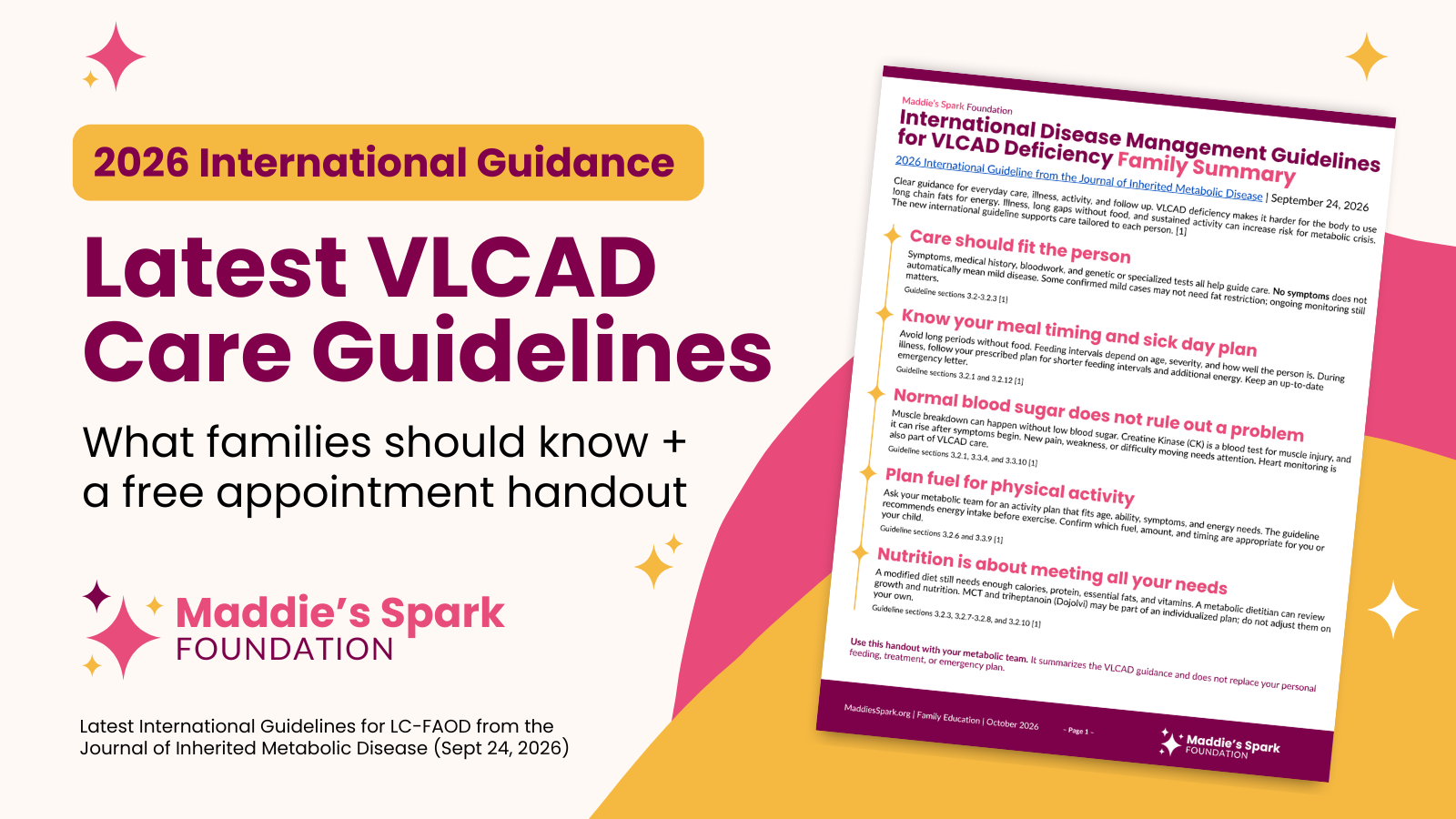
Living with VLCAD deficiency means making decisions every day about food, activity, illness, and when to seek medical care. For families, having clear guidance matters, especially when caring for a rare condition that many healthcare professionals may never have encountered.
On September 24, 2026, the Journal of Inherited Metabolic Disease published the International Guideline on the Diagnosis, Treatment, and Monitoring of Long-Chain Fatty Acid Oxidation Disorders (LC-FAOD). These disorders include VLCAD deficiency.
The guideline brings together available research and the experience of an international group of 34 members, including physicians, nurses, dietitians, and patient/family representation. Dr. Jerry Vockley, whose VLCAD research Maddie’s Spark Foundation supports, is among the authors. The goal is to help healthcare teams provide more consistent, individualized care throughout a person’s life. [1]
For families, this publication provides a useful starting point for conversations with their metabolic team. Here are some of its most meaningful takeaways.
Care Should Reflect the Individual
VLCAD affects people differently. Some experience serious complications early in life. Others have muscle symptoms later on, while some individuals identified through newborn screening remain without symptoms.
The guideline emphasizes that treatment decisions should consider several pieces of information together: medical history, symptoms, bloodwork, genetic results, and specialized testing when available.
Being symptom-free does not automatically mean a person has mild VLCAD. Someone who appears well may still have laboratory or testing results that suggest they need additional precautions.
For people with a confirmed mild form, an unrestricted diet may be appropriate under their metabolic team’s guidance. Others need limits on long-chain fat and alternative energy sources. Monitoring remains important in either situation, and care plans should be reassessed over time. (Guideline sections 3.2–3.2.3.) [1]
Families should discuss any possible changes with their metabolic specialist and dietitian before adjusting their routine.
Avoiding Long Gaps Without Food Remains Essential
VLCAD makes it harder for the body to turn long-chain fats into energy. This becomes especially important when the body needs to rely on stored fuel, such as during fasting, illness, or sustained activity.
The guideline reinforces regular meals and snacks to help prevent an energy shortage. However, there is no single fasting limit that is appropriate for everyone. Feeding intervals should reflect age, disease severity, and clinical stability.
During illness, those intervals may need to become shorter, with additional carbohydrates provided according to the person’s sick-day plan. (Guideline section 3.2.1.) [1]
For families, a useful step is to confirm that their written care plan clearly explains both everyday feeding intervals and what changes when their child—or an adult living with VLCAD—is sick.
Every Family Needs a Clear Sick-Day Plan
Illness can increase energy needs at the same time that appetite drops. Vomiting or difficulty eating can make it harder to meet those needs.
The guideline recommends that patients and caregivers receive an individualized sick-day protocol and emergency letter to support early treatment at home and in medical settings. (Guideline section 3.2.12.) [1]
A practical plan should help families understand:
When to begin the sick-day routine.
What food, drinks, or prescribed feeds to provide.
When to contact the metabolic team.
When to seek emergency care.
Symptoms such as vomiting, poor intake, unusual sleepiness, muscle pain, or dark urine can require prompt attention. Follow the individual emergency plan rather than waiting for several warning signs to appear.
When hospital treatment is needed, the guideline recommends metabolic specialist involvement and intravenous glucose to help restore an adequate energy supply. (Guideline sections 3.2.11–3.2.13.) [1]
Blood Sugar Is Only Part of the Picture
A normal blood sugar result does not rule out other VLCAD complications. Muscle breakdown, known as rhabdomyolysis, can occur without low blood sugar. (Guideline section 3.2.1.) [1]
CK, or creatine kinase, is a blood test commonly used to assess muscle injury. The guideline notes that CK can rise after symptoms begin, so an earlier reassuring result may not capture what is happening later.
New muscle pain, weakness, or difficulty moving deserves clinical attention. Symptoms, examination findings, and laboratory results need to be considered together. (Guideline section 3.3.10.) [1]
Ongoing VLCAD care also includes monitoring for heart complications, with the schedule tailored to the person’s condition and symptoms. (Guideline sections 3.3.2 and 3.3.4.) [1]
Physical Activity Should Have an Individual Plan
The guideline recommends individualized exercise plans for people with LC-FAOD, adjusted for age, physical ability, symptoms, and nutrition needs.
It also emphasizes providing energy before exercise to help meet the extra demand. Depending on the person’s care plan, that fuel may include carbohydrates, medium-chain fats, or triheptanoin. (Guideline sections 3.2.6 and 3.3.9.) [1]
For families, this is a reason to talk with the metabolic team about everyday activities—not only organized sports. Playground time, school activities, camp, and long outings may also need planning.
The goal is to support participation with appropriate fuel and adjustments based on the individual’s needs.
Nutrition Means Meeting All of the Body’s Needs
A fat-restricted diet still needs to provide enough energy, protein, essential fats, and vitamins for growth and health.
The guideline recommends monitoring nutritional status, including essential fatty acids and certain vitamins when appropriate. A metabolic dietitian can help families balance these needs as feeding habits and activity levels change. (Guideline sections 3.2.3, 3.2.7, and 3.2.8.) [1]
For infants, the guideline supports including breast milk when clinically appropriate. Some babies can breastfeed exclusively; others need a combination with specialized formula or a more carefully modified feeding approach. These decisions depend on disease severity and clinical status. (Guideline section 3.2.4.) [1]
The guideline also recognizes triheptanoin, known as Dojolvi, as a treatment option for symptomatic patients. It is one part of an individualized treatment plan, alongside nutrition, fasting precautions, and monitoring. (Guideline section 3.2.10.) [1]
The Guidance Also Shows Where Research Is Needed
Many recommendations rely on expert agreement because large, high-quality studies in LC-FAOD remain limited. The guideline’s systematic literature search covered research through July 2022, with additional selected publications included.
That matters when interpreting a newly published guideline: publication brings the recommendations together, but it does not mean every recommendation comes from a new study. (Guideline sections 2.1 and 4.) [1]
The authors also recognize the need to better understand quality of life, including how symptoms, dietary management, medical care, school, work, and emotional wellbeing affect patients and families. (Guideline section 3.3.8.) [1]
For Maddie’s Spark Foundation, these gaps reinforce why research matters. Families need stronger evidence, better disease-management tools, and treatments that improve daily life.
Bringing the Guideline to Your Next Appointment
You do not need to interpret this lengthy medical publication on your own. It can help guide a conversation with the professionals who know your family’s situation.
Consider asking your metabolic team:
Does this guidance suggest any updates to our current care plan?
Are our everyday and sick-day feeding instructions clear?
What should our activity-fueling plan include?
Which symptoms should prompt a call or emergency evaluation?
Is our nutrition and heart-monitoring schedule appropriate?
This international guideline is a meaningful step toward more consistent care. Its value for families will come through clear instructions, thoughtful follow-up, and care that reflects the person living with VLCAD.
Read the full guideline in the Journal of Inherited Metabolic Disease.
You do not need to interpret this lengthy medical publication on your own. We’ve created a family-friendly handout summarizing key guidance and questions to discuss with your metabolic team.
Download it and bring it to your next appointment to review your current care plan, including meal timing, sick-day instructions, activity fueling, and ongoing monitoring.
This post summarizes recommendations, with a focus on VLCAD. Recommendations differ across LC-FAOD conditions and individual needs. Review any changes to feeding, medications, supplements, or activity with your metabolic care team.
Reference
Grünert SC, Bhattacharya K, Karall D, Langeveld M, Rohr F, Visser G, Vockley J, Kenneson A, Singh RH, Spiekerkoetter U, International LC-FAOD Guideline Workgroup. International Guideline on the Diagnosis, Treatment, and Monitoring of Long-Chain Fatty Acid Oxidation Disorders (LC-FAOD). Journal of Inherited Metabolic Disease. 2026;49(5). Published online September 24, 2026. https://doi.org/10.1002/jimd.70251
